What’s the difference in evidence between unlawful detainer and acción reivindicatoria?
The evidentiary requirement for unlawful detainer and acción reivindicatoria is distinct from each other. In unlawful detainer, it is required that the aggrieved party allege lawful possession that turned to be unlawful… However, in an acción reivindicatoria, no such evidence is required since it is an acción based on ownership… Simply put, evidence of prior physical possession and of the subsequent unlawfulness of possession is irrelevant.
Spouses Tobias v. Gonzales, G.R. No. 232176, February 17, 2021
Can a person choose their legal gender if they are biologically intersex?
If a person is naturally intersex, born with both male and female characteristics, the law allows them, upon reaching adulthood, to decide their legal gender based on what they genuinely and reasonably identify as.
Republic v. Jennifer B. Cagandahan, G.R. No. 166676, September 12, 2008
Suspended sentence applies even if the child is already eighteen at judgment
Suspension of sentence shall still apply even if the child in conflict with the law is already eighteen years of age or more at the time of the pronouncement of guilt.
Dorado v. People, G.R. No. 216671, October 3, 2016
Are there different kinds of illegitimate children under Philippine law?
Under Article 176 of the Family Code, all illegitimate children are generally placed under one category, without any distinction between natural and spurious. The concept of "natural child" is important only for purposes of legitimation. Without the subsequent marriage, a natural child remains an illegitimate child.
Briones v. Miguel, G.R. No. 156343, October 18, 2004
Can a person remarry without a court declaration of nullity?
Even if a marriage is void or the spouses have long separated, a person cannot remarry unless a court has first declared the marriage null and void. Without that judicial declaration, the second marriage is invalid — and can even lead to criminal liability for bigamy.
See: De Guzman y Jumaquio v. People (G.R. No. 224742)
Why is an ejectment case different from an ownership case?
Ejectment involves only material possession (possession de facto), while acción reivindicatoria involves ownership. There may be identity of parties and subject matter, but not of the cause of action or the relief prayed for.
Spouses Tobias v. Gonzales, G.R. No. 232176, February 17, 2021
Effect of Forgery in Land Transfers
A fake deed cannot transfer ownership. Even if a forged sale is registered with the Registry of Deeds, the true owner remains the rightful owner. Fraud cannot defeat a genuine title.
See: Mendiola v. Sangalang, G.R. No. 205283, June 7, 2017
When can a motion to quash a criminal case be granted?
A motion to quash would be granted if defect in the information is evident on its face. If the defect can be cured by amendment or if it is based on the ground that the facts charged do not constitute an offense, the prosecution is given by the court the opportunity to correct the defect by amendment.
People v. Odtuhan, G.R. No. 191566, July 17, 2013
Can an appellate court overturn the trial court’s findings on witness credibility?
Factual findings of the trial court and its evaluation of the credibility of witnesses and their testimonies are entitled to great respect and will not be disturbed on appeal, unless the trial court is shown to have overlooked, misapprehended, or misapplied any fact or circumstance of weight and substance.
People v. ZZZ, G.R. No. 228828, July 24, 2019
How do you prove the relationship between the accused and the victim in parricide?
In the case of parricide of a spouse, the best proof of the relationship between the accused and the deceased would be the marriage certificate. The testimony of the accused of being married to the victim, in itself, may also be taken as an admission against penal interest.
People v. Paycana, G.R. No. 179035, April 16, 2008
Exemption from criminal liability does not erase civil liability
Exemption from criminal liability under RA 9344 does not include exemption from civil liability, which shall be enforced in accordance with existing laws.
Dorado v. People, G.R. No. 216671, October 3, 2016
Delay in medical treatment does not break criminal liability
Delay or inadequacy in giving medical treatment does not break the causal connection between the wrongful act of the accused and the injuries or death of the victim. A person who inflicts injuries is responsible for the consequences of the criminal act, including death that supervenes from the injuries.
CICL XXX v. People, G.R. No. 238798, March 14, 2023
Corporation by Estoppel: When Equity Treats an Unorganized Entity as a Corporation
The doctrine of corporation by estoppel rests on the idea that if the Court were to disregard the existence of an entity which entered into a transaction with a third party, unjust enrichment would result as some form of benefit have already accrued on the part of one of the parties. Thus, in that instance, the Court affords upon the unorganized entity corporate fiction and juridical personality for the sole purpose of upholding the contract.
The Missionary Sisters of Our Lady of Fatima v. Alzona, G.R. No. 224307, August 6, 2018
Effect of the Death of the Accused Pending Appeal
If an accused dies while the case is still on appeal, both the criminal case and any civil damages based solely on the crime are extinguished. But if the civil claim is based on another source — like a contract or negligence — it can still be filed separately in a civil court.
See: People v. Lipata, G.R. No. 200302, April 20, 2016
Who inherits the estate when there are no children, parents, or spouse?
Only the presence of descendants, ascendants or illegitimate children excludes collateral relatives from succeeding to the estate of the decedent. The presence of legitimate, illegitimate, or adopted child or children of the deceased precludes succession by collateral relatives. Conversely, if there are no descendants, ascendants, illegitimate children, or a surviving spouse, the collateral relatives shall succeed to the entire estate of the decedent.
Carlos v. Sandoval, G.R. No. 179922, December 16, 2008
Summary Judgment Applies Only When There Is No Genuine Issue of Material Fact
Summary judgment is a procedural device that allows the court to promptly dispose of a case when the pleadings, depositions, admissions, affidavits, and other matters on record show that there is no genuine issue of fact requiring trial. It applies when the material facts are undisputed and the court can decide the case by simply applying the law to those established facts. Pasted text
Cham Teng Hui and James L. Cham v. Wilson P. Cham and Bernard P. Cham, G.R. No. 224550, March 6, 2023.
Can a landowner immediately take back possession from an occupant?
The owner of real property is entitled to possession as an attribute of ownership. However, the owner cannot simply wrest possession from whoever is in actual occupation. To recover possession, the owner must resort to the proper judicial remedy and meet the necessary conditions for such action to prosper
Spouses Tobias v. Gonzales, G.R. No. 232176, February 17, 2021
Does the validity of a second marriage affect a bigamy case?
The question of the validity of the second marriage is, therefore, a prejudicial question, because determination of the validity of the second, marriage is determinable, in the civil action and must precede the criminal action for bigamy.
Pulido v. People, G.R. No. 220149, July 27, 2021
The prosecution bears the burden of proving discernment
For a minor above fifteen but below eighteen years of age to be criminally liable, the prosecution must prove beyond reasonable doubt, by direct or circumstantial evidence, that the minor acted with discernment.
Dorado v. People, G.R. No. 216671, October 3, 2016
Discernment as Basis for Criminal Liability of a Minor
“Discernment” means the ability of a child to understand right from wrong. Courts look at the child’s actions, attitude, and behavior before, during, and after the crime, even at trial, to decide if the child truly understood what they were doing and its consequences.
See: CICL XXX v. People & Redoquerio (G.R. No. 237334, August 14, 2019)
Discernment is different from intent
Intent and discernment are two distinct concepts. Intent refers to the desire to commit the act, while discernment relates to the moral significance that the person ascribes to the act.
Dorado v. People, G.R. No. 216671, October 3, 2016
What is a compromise agreement under Philippine law?
A compromise agreement is defined as a contract whereby the parties make reciprocal concessions in order to resolve their differences and thus avoid or put an end to a lawsuit.
Hapitan v. Spouses Lagradilla, G.R. No. 170004, January 13, 2016
May an alien husband own land in the Philippines?
No. When a parcel of land is purchased by a Filipino spouse using funds provided by an alien spouse, ownership is vested solely in the Filipino spouse—even if the funds came from the alien.
Matthews v. Taylor (G.R. No. 164584, June 22, 2009)
The State’s Duty as Parens Patriae to Protect Children
The State, as parens patriae, is under the obligation to minimize the risk of harm to those who, because of their minority, are as yet unable to take care of themselves fully.
Malto v. People, G.R. No. 164733, September 21, 2007
Only Age and Sexual Intercourse Need Be Proven in Statutory Rape
In statutory rape cases, the only elements that need to be proved are the age of the victim and sexual intercourse. Consent is immaterial, and corroborative physical evidence is not indispensable if the victim’s testimony is credible and consistent.
People v. ZZZ, G.R. No. 228828, July 24, 2019
The Writ of Amparo Protects Life, Liberty, and Security
The writ of amparo is an equitable and extraordinary remedy primarily meant to address concerns such as, but not limited to, extrajudicial killings and enforced disappearances, or threats thereof.
Sanchez v. Darroca (G.R. No. 242257, Oct. 15, 2019)
Fraudulent Title Holders Are Mere Trustees
The indefeasibility of a Torrens title should not be used as a means to perpetrate fraud against the rightful owner of real property. If the registration of the land is fraudulent, the person in whose name the land is registered holds it as a mere trustee.
Spouses Yu v. Ayala Land, Inc., G.R. Nos. 173120 & 173141, July 26, 2017
Nature of Reconstitution: Restoration, Not Creation of Title
Reconstitution restores a lost or destroyed Torrens title to its original form without creating a new title or transferring ownership. Its purpose is to reproduce the original certificate after complying with the procedure under R.A. No. 26.
See: Republic v. Mancao (G.R. No. 174185, July 22, 2015)
Who has the better right when land is registered under two different names?
In case land has been registered under the Land Registration Act in the name of two different persons, the earlier in date shall prevail.
Legarda v. Saleeby, G.R. No. L-8936, Oct. 2, 1915
Favorable juvenile justice laws apply retroactively
Republic Act No. 9344, or the Juvenile Justice and Welfare Act of 2006, as amended, applies retroactively for the benefit of a child in conflict with the law pursuant to the principle that penal laws favorable to the accused are given retroactive effect.
Dorado v. People, G.R. No. 216671, October 3, 2016
What is fraud in relation to the making of a will?
Fraud 'is a trick, secret device, false statement, or pretense, by which the subject of it is cheated. It may be of such character that the testator is misled or deceived as to the nature or contents of the document which he executes, or it may relate to some extrinsic fact, in consequence of the deception regarding which the testator is led to make a certain will which, but for the fraud, he would not have made.
Ortega v. Valmonte, G.R. No. 157451, December 6, 2005
Insanity Requires Complete Deprivation of Intelligence
The law excuses a person from criminal liability only if they were completely deprived of reason or understanding when the crime was committed. Simply being mentally ill, unstable, or emotionally disturbed is not enough to exempt one from punishment.
See: People v. Jesse Haloc y Codon, G.R. No. 227312, September 5, 2017
Doctrine of Intergenerational Responsibility in Environmental Law
The Supreme Court ruled that children have the right to go to court to protect the environment — not only for themselves, but for the generations yet to come. This is the doctrine of intergenerational responsibility, which makes the constitutional right to a healthy and balanced ecology enforceable by all citizens.
See: Oposa v. Factoran (G.R. No. 101083, July 30, 1993)
Foreigners Cannot Acquire Private Land in the Philippines
Aliens are disqualified from acquiring private lands in the Philippines under Section 7, Article XII of the 1987 Constitution, and any attempt to do so—whether directly or indirectly, even by way of trust or reimbursement—circumvents the constitutional prohibition and is void.
Muller v. Muller, G.R. No. 149615, August 29, 2006
Can children question their parent’s marriage after the parent has died?
Children can question their late parent’s marriage if it affects their inheritance rights. In this case, the Supreme Court ruled that they have the legal personality to file a petition to declare their father’s marriage to their stepmother void, since it determines who lawfully inherits from him.
See: Niñal vs. Bayadog (G.R. No. 133778, March 14, 2000)
Does the law prohibit property sales between partners in a common-law relationship?
Yes. The law prohibits spouses, and even live-in partners, from selling property to each other. This rule exists to prevent abuse, such as transferring property to hide assets or defraud others. The Court explained that treating unmarried partners more favorably than married couples would be unfair and contrary to public policy.
See: Ching v. Goyanko, G.R. No. 165879, November 10, 2006
Right of the accused to Be Informed of the Nature and Cause of Accusation
Every person charged with a crime has the right to know exactly what they are accused of and why. This ensures fairness, allowing the accused to prepare a proper defense and avoid surprise or injustice.
See: Malto v. People, G.R. No. 164733, September 21, 2007
Ejectment Cases Resolve Possession, Not Ownership
In an ejectment suit (action interdictal), the sole issue is the right of physical or material possession over the subject real property independent of any claim of ownership by the parties involved. Ownership over the property is immaterial and is only passed upon provisionally for the limited purpose of determining which party has the better right to possession.
Spouses Tobias v. Gonzales, G.R. No. 232176, February 17, 2021
A child who acted with discernment does not immediately proceed to trial
A child above fifteen but below eighteen years of age who acted with discernment does not immediately proceed to trial. The child may undergo diversion, and only if diversion is unsuccessful or other grounds under the law are present may the case proceed to preliminary investigation and trial.
Dorado v. People, G.R. No. 216671, October 3, 2016
Acción Reivindicatoria Determines Ownership and Possession
Acción reivindicatoria or acción de reivindicación is an action whereby the plaintiff alleges ownership over a parcel of land and seeks recovery of its full possession. The judgment in such a case determines the ownership of the property and awards the possession of the property to the lawful owner.
Heirs of Alfonso Yusingco v. Busilak, G.R. No. 210504, January 24, 2018
Can an elderly or weak-minded person still make a valid will?
A person doesn’t lose the right to make a will just because they are old, sick, or weak-minded. What matters is that they still understand what they are doing, what they own, and who they want to give it to. The law protects their last wishes as long as they act with understanding and intent.
See: Ortega v. Valmonte, G.R. No. 157451, December 6, 2005
Qualified Theft Requires Special Trust, Not Mere Access to Money
For theft to be qualified by grave abuse of confidence, the prosecution must prove more than employment, access to money, or handling of company funds. It must establish a relationship of special trust or a higher degree of confidence between the offended party and the accused. Without that proof, the crime may only be simple theft, and abuse of confidence may be treated merely as a generic aggravating circumstance.
Sonia Balagtas v. People of the Philippines, G.R. No. 257483, October 30, 2024
A child above fifteen but below eighteen is exempt unless discernment is proven
A child above fifteen years but below eighteen years of age is likewise exempt from criminal liability and shall be subjected to an intervention program, unless the child acted with discernment.
Dorado v. People, G.R. No. 216671, October 3, 2016
Discernment must be proven before a minor may be criminally liable
A child above fifteen but below eighteen years of age cannot be held criminally liable unless the prosecution proves, as a separate circumstance and beyond reasonable doubt, that the child acted with discernment. Intent to commit the act does not automatically prove discernment, and in the absence of a determination of discernment, the child is deemed exempt from criminal liability, without prejudice to civil liability.
Dorado v. People, G.R. No. 216671, October 3, 2016
Intent to Gain in Qualified Theft
Qualified theft, being malum in se, requires animus lucrandi. Intent to gain is presumed from unlawful taking, inferred from overt acts, and actual gain is immaterial — though the presumption may be rebutted.
Pedro J. Amarille v. People, citing Valenzuela v. People
Trademark rights arise only from registration validly made under the Intellectual Property Code.
Although ownership of a trademark under the Intellectual Property Code is generally acquired through registration rather than prior use, Section 122 requires that the registration be "made validly" in accordance with the law. A registration procured in bad faith, fraudulently, or contrary to the provisions of the Intellectual Property Code does not confer protectable trademark rights and may be cancelled under Section 151.1(b). Prior use, although no longer the source of ownership, remains relevant in determining whether a subsequent applicant acted in bad faith.
HEIRS OF KING SI BIAK v. PANCITERIA LIDO CHINESE CUISINE CO.; G.R. No. 279019, August 12, 2026; First Division, Hernando, J.
Rape is committed by carnal knowledge under the circumstances stated in Article 266-A
Rape is committed by having carnal knowledge of a woman under any of the circumstances provided in Article 266-A of the Revised Penal Code, as amended by Republic Act No. 8353, including through force, threat, or intimidation.
People v. Balanza, G.R. No. 207943, September 11, 2017
What is an acción publiciana?
Acción publiciana is an ordinary civil proceeding to determine the better right of possession of real property independently of title. Where the parties raise the issue of ownership, the courts may pass upon the issue to determine who between them has the right to possess the property. This adjudication, however, is not a final and binding determination of ownership.
Macutay v. Samoy, G.R. No. 205559, December 2, 2020
Can you get your money back from an illegal transaction?
One who loses his money or property by knowingly engaging in an illegal contract may not maintain an action for his losses.
Heirs of Satramdas V. Sadhwani v. Gop S. Sadhwani (G.R. No. 217365, Aug. 14, 2019)
Three Remedies to Recover Property
Accion interdictal comprises two distinct causes of action, namely, forcible entry (detentación) and unlawful detainer (desahucio)… Accion publiciana is the plenary action to recover the right of possession… On the other hand, accion reivindicatoria is an action to recover ownership also brought in the proper regional trial court in an ordinary civil proceeding.
Spouses Tobias v. Gonzales, G.R. No. 232176, February 17, 2021
Conviction of a child does not immediately lead to execution of judgment
Once a child in conflict with the law is found guilty of the offense charged, the court shall not immediately execute its judgment, but shall place the child under suspended sentence and impose appropriate disposition measures.
Dorado v. People, G.R. No. 216671, October 3, 2016
Who decides when a marriage should end?
The new Rule recognizes that the husband and the wife are the sole architects of a healthy, loving, peaceful marriage. They are the only ones who can decide when and how to build the foundations of marriage. The spouses alone are the engineers of their marital life. They are simultaneously the directors and actors of their matrimonial true-to-life play. Hence, they alone can and should decide when to take a cut, but only in accordance with the grounds allowed by law.
Carlos v. Sandoval, G.R. No. 179922, December 16, 2008
Simulation of Contracts Under Article 1345 of the Civil Code
Article 1345, Civil Code: “Simulation of a contract occurs when the parties do not really intend to be bound by it. It is absolutely simulated if it does not produce any legal effect whatsoever.
Pua v. Court of Appeals, G.R. No. 134992, November 20, 2000
Judgment for Possession Is In Personam
A court ruling giving possession of land applies only to the people involved in the case, not to everyone. It doesn’t make you the owner against the whole world; it only settles who has the right to possess between the parties.
See: Heirs of Alfonso Yusingco v. Busilak, G.R. No. 210504, January 24, 2018
What kind of evidence can prove insanity?
Insanity may be shown by surrounding circumstances fairly throwing light on the subject, such as evidence of the alleged deranged person's general conduct and appearance, his acts and conduct inconsistent with his previous character and habits, his irrational acts and beliefs, and his improvident bargains.
People v. Jesse Haloc y Codon, G.R. No. 227312, September 5, 2017
How can a person prove filiation or being a child of someone?
One can prove illegitimate filiation through the record of birth appearing in the civil register or a final judgment, an admission of legitimate filiation in a public document or a private handwritten instrument and signed by the parent concerned, or the open and continuous possession of the status of a legitimate child, or any other means allowed by the Rules of Court and special laws.
De Castro v. De Castro, G.R. No. 160172, February 13, 2008
Torrens Title is Not a Shield for Fraud
The indefeasibility of the Torrens title should not be used as a means to perpetrate fraud against the rightful owner of real property. Good faith must concur with registration because, otherwise, registration would be an exercise in futility. A Torrens title does not furnish a shield for fraud.
Mendiola v. Sangalang (2017)
Who can appeal the dismissal of a criminal case?
In criminal cases, the People is the real party-in-interest and only the Office of the Solicitor General (OSG) can represent the People in criminal proceedings before this Court. Inasmuch as the private offended party is but a witness in the prosecution of offenses, the interest of the private offended party is limited only to the aspect of civil liability. It follows therefore that in criminal cases, the dismissal of the case against an accused can only be appealed by the Solicitor General, acting on behalf of the State.
Bumatay v. Bumatay, G.R. No. 191320, April 25, 2017
Imperfect Title from Long Possession; Due Process Limits State Power
Open, continuous, exclusive, and notorious possession of land for the period required by law gives rise to an imperfect title that may be confirmed by the State. The State may not, without evidence and due process, indiscriminately oppose or take such property.
Republic v. Spouses Noval, G.R. No. 170316, September 18, 2017
Marriage is considered a legal institution
Marriage is a legal relationship, entered into through a legal framework, and enforceable according to legal rules. Law stands at its very core. Due to this inherent ‘legalness’ of marriage, the constitutional right to marry cannot be secured simply by removing legal barriers to something that exists outside of the law. Rather, the law itself must create the ‘thing’ to which one has a right.
Falcis v. Civil Registrar General, G.R. No. 217910, September 3, 2019
Must the prosecution prove the identity and qualifications of the mandatory insulating witnesses?
Yes, the prosecution prove the identity and qualifications of the mandatory insulating witnesses. In prosecutions under the Comprehensive Dangerous Drugs Act, the prosecution must prove not only the presence of the mandatory insulating witnesses during the inventory of the seized drugs, but also their identities and credentials as the persons required by Section 21 of R.A. No. 9165, as amended by R.A. No. 10640. Their status cannot simply be presumed. Failure to prove their identity creates reasonable doubt as to the first link in the chain of custody and, ultimately, the identity of the corpus delicti.
The testimony of a child rape victim is given full weight and credit
The testimony of a child victim in a rape case is given full weight and credit when it is straightforward, trustworthy, and sufficient to show that rape was committed.
People v. Balanza, G.R. No. 207943, September 11, 2017
How do courts determine if a person is insane?
The vagaries of the mind can only be known by outward acts: thereby we read the thoughts, motives and emotions of a person; and through which we determine whether his acts conform to the practice of people of sound mind.
People v. Jesse Haloc y Codon, G.R. No. 227312, September 5, 2017
Is a court decision required to declare a marriage void?
No judicial decree is necessary in order to establish the nullity of a marriage. “A void marriage does not require a judicial decree to restore the parties to their original rights or to make the marriage void but though no sentence of avoidance be absolutely necessary, yet as well for the sake of good order of society as for the peace of mind of all concerned, it is expedient that the nullity of the marriage should be ascertained and declared by the decree of a court of competent jurisdiction.”
Ablaza v. Republic, G.R. No. 158298, August 11, 2010
What constitutes the offense of child sexual abuse under the law?
The mere act of having sexual intercourse or committing lascivious conduct with a child who is exploited in prostitution or subjected to sexual abuse constitutes the offense.
Malto v. People, G.R. No. 164733, September 21, 2007
Article 26 Applies to Foreign Judgments of Annulment Based on Bigamy
The principle in Article 26 of the Family Code applies in a marriage between a Filipino and a foreign citizen who obtains a foreign judgment nullifying the marriage on the ground of bigamy. The Filipino spouse may file a petition abroad to declare the marriage void on the ground of bigamy. The principle in the second paragraph of Article 26 of the Family Code applies because the foreign spouse, after the foreign judgment nullifying the marriage, is capacitated to remarry under the laws of his or her country.
Fujiki v. Marinay, G.R. No. 196049, June 26, 2013
Does paying real property tax make you the owner of the land?
Payment of taxes is not conclusive proof of ownership, but it indicates possession as an owner. When combined with long, continuous possession, it becomes strong evidence of ownership.
Republic v. Spouses Noval, G.R. No. 170316, September 18, 2017
What is the effect of an absolutely simulated contract?
A contract made only to appear real when the parties never intended it to have legal effect is called an absolutely simulated contract. The law treats it as if it never existed, producing no rights or obligations.
See: Pua v. Court of Appeals, G.R. No. 134992, November 20, 2000
What are the two kinds of divorce recognized in law?
Divorce means the legal dissolution of a lawful union for a cause arising after marriage. But divorces are of different types. The two basic ones are (1) absolute divorce or a vinculo matrimonii and (2) limited divorce or a mensa et thoro. The first kind terminates the marriage, while the second suspends it and leaves the bond in full force.
Amor-Catalan v. Court of Appeals, G.R. No. 167109, February 6, 2007
When Can a Broken Promise to Marry Become Psychological Violence?
A breach of promise to marry is not, by itself, psychological violence under R.A. No. 9262. However, acts surrounding the withdrawal from a marriage commitment may constitute psychological violence under Section 5(i) when they are willfully employed in a manner that causes mental or emotional anguish to a woman with whom the offender has a dating or sexual relationship.
XXX v. People of the Philippines G.R. No. E-00648, July 29, 2026 First Division, Hernando, J.
Is same-sex marriage recognized under Philippine law?
No. The Family Code definition of marriage as between a man and a woman is constitutional and reflects the state’s legitimate interest in preserving the family as a basic social institution. Same-sex marriage is not recognized in Philippine law.
Falcis v. Civil Registrar General, G.R. No. 217910, September 3, 2019
Children below fifteen are exempt from criminal liability
A child fifteen years of age or under at the time of the commission of the offense is exempt from criminal liability, but shall be subjected to an intervention program pursuant to RA 9344.
Dorado v. People, G.R. No. 216671, October 3, 2016
Can a child validly enter into a contract?
A child cannot give consent to a contract under our civil laws. This is on the rationale that she can easily be the victim of fraud, as she is not capable of fully understanding or knowing the nature or import of her actions.
Malto v. People, G.R. No. 164733, September 21, 2007
Discernment is not presumed in a child in conflict with the law
When a minor above fifteen but below eighteen years old is charged with a crime, it cannot be presumed that he or she acted with discernment. The prosecution must specifically prove, as a separate circumstance, that the child committed the alleged crime with discernment.
Dorado v. People, G.R. No. 216671, October 3, 2016
A victim’s spontaneous statement may be admitted as part of the res gestae
A statement made by a person while a startling occurrence is taking place, or immediately prior or subsequent thereto, under the stress of excitement caused by the occurrence, may be admitted in evidence as part of the res gestae.
CICL XXX v. People, G.R. No. 238798, March 14, 2023
Definition of Circumstantial Evidence
Circumstantial evidence is “proof of collateral facts and circumstances from which the existence of the main fact may be inferred according to reason and common experience.”
People v. ZZZ (G.R. No. 228828, July 24, 2019)
In Dubio Pro Reo: When in Doubt, Rule for the Accused
In every criminal case, the law favors the accused whenever there is reasonable doubt. If the evidence does not clearly prove guilt, the person must be acquitted. This is the principle of “in dubio pro reo” — when in doubt, rule for the accused.
See: Pulido v. People, G.R. No. 220149, July 27, 2021
Failure to State vs. Lack of Cause of Action
Failure to state a cause of action concerns the sufficiency of the complaint on its face — whether it alleges facts showing a right violated by the defendant.
Lack of cause of action concerns the absence of factual or evidentiary basis — discovered only after trial when the plaintiff’s evidence fails to prove the claim
See: PNB v. Rivera, G.R. No. 189577, April 20, 2016
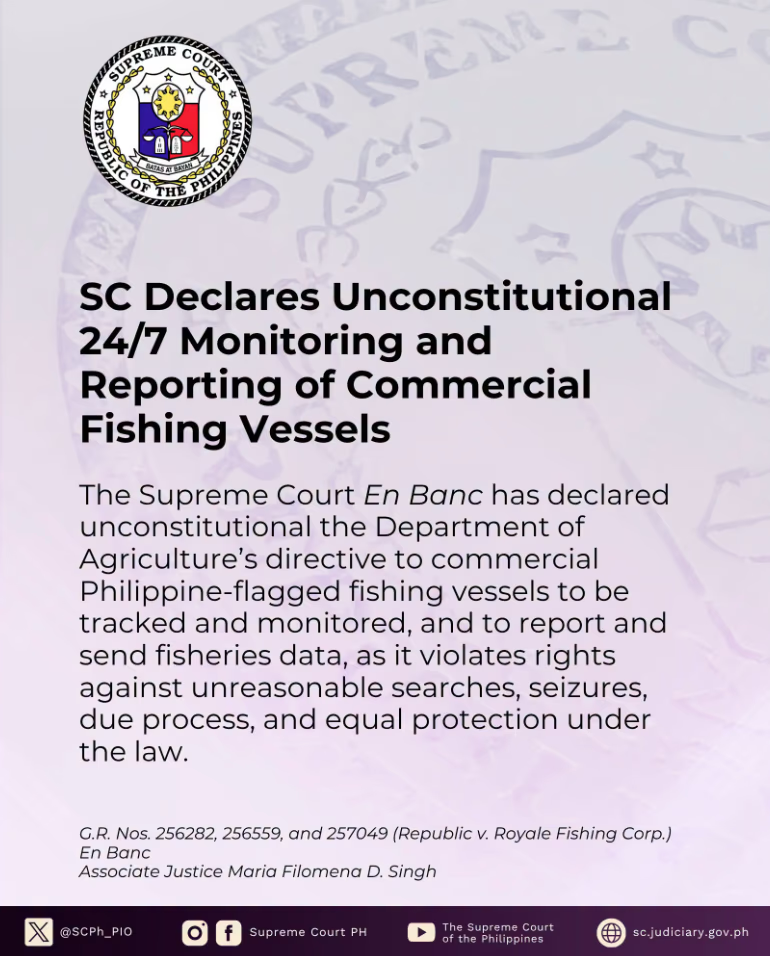
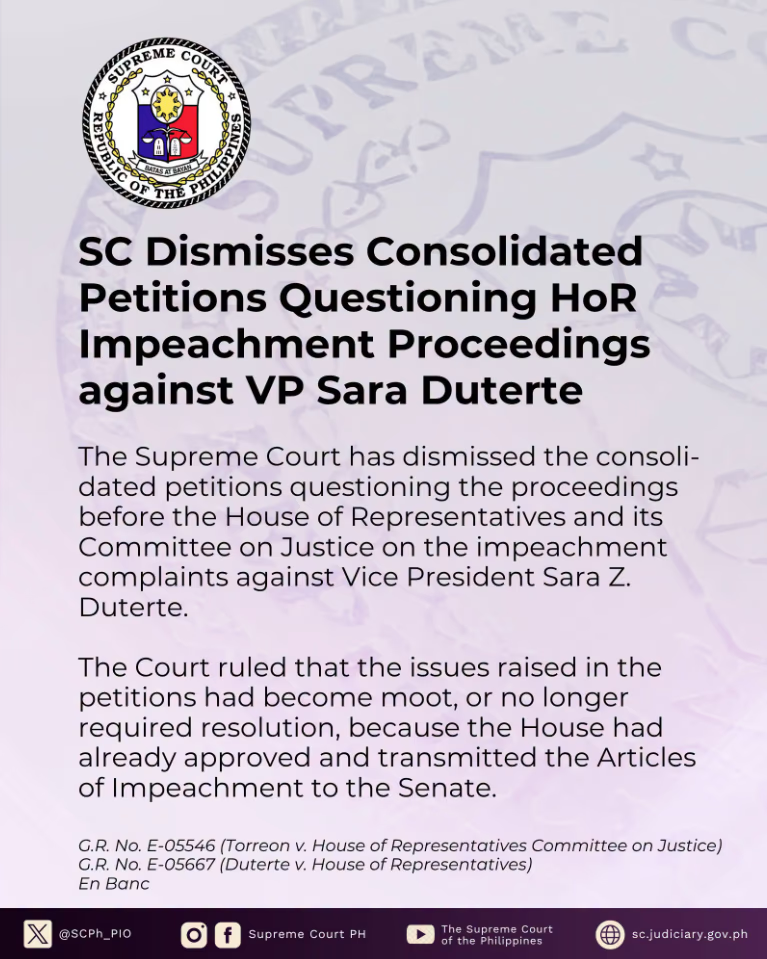
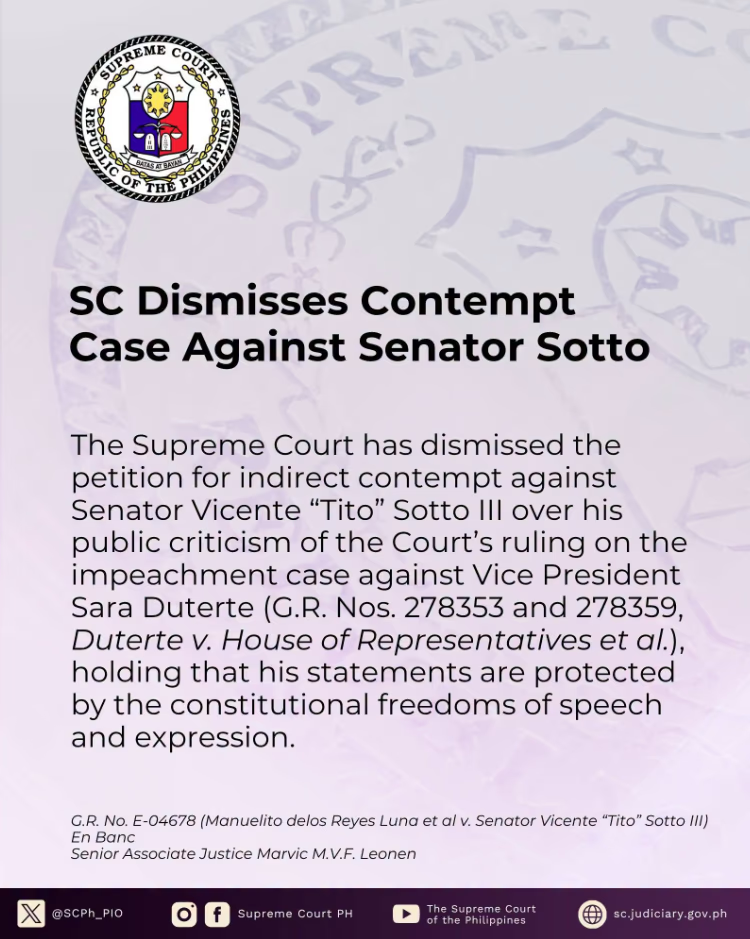
Sara Z. Duterte v. House of Representatives; Torreon, et al. v. House of Representatives, G.R. Nos. 278353 and 278359, July 25, 2025.
Impeachment is a sui generis constitutional process that is primarily legal, though with political characteristics; hence, it is not beyond judicial review, and the Bill of Rights, especially due process and the right to speedy disposition of cases, applies to the entire impeachment process. Articles of Impeachment filed in violation of the one-year bar or without the required opportunity to be heard are unconstitutional, void ab initio, and do not vest jurisdiction in the Senate sitting as an impeachment court.
Sara Z. Duterte v. House of Representatives; Torreon, et al. v. House of Representatives, G.R. Nos. 278353 and 278359, July 25, 2025.
What is forum shopping?
Forum shopping is the filing of multiple suits involving the same parties for the same cause of action, either simultaneously or successively, to obtain a favorable judgment. It exists where litis pendentia is present or where a final judgment in one case will amount to res judicata in another.
Spouses Tobias v. Gonzales, G.R. No. 232176, February 17, 2021
Parents Are Primarily Liable for Civil Damages Caused by Their Minor Children
The parents are and should be held primarily liable for the civil liability arising from criminal offenses committed by their minor children under their legal authority or control, or who live in their company, unless it is proven that the former acted with the diligence of a good father of a family to prevent such damages.
CICL XXX v. People & Redoquerio, G.R. No. 237334, August 14, 2019
Rape May Be Proven Through Circumstantial Evidence
In the absence of direct evidence, a resort to circumstantial evidence is usually necessary in proving the commission of rape. This is because the crime is generally unwitnessed and very often only the victim is left to testify for [him or] herself. It becomes even more difficult when the complex crime of rape with homicide is committed because the victim could no longer testify.
People v. ZZZ, G.R. No. 228828, July 24, 2019
Exemption from Criminal Liability of a Minor Does Not Extinguish Civil Liability
It is well-settled that “every person criminally liable is also civilly liable.” However, it does not follow that a person who is not criminally liable is also free from civil liability. Exemption from criminal liability does not always include exemption from civil liability.
CICL XXX v. People & Redoquerio, G.R. No. 237334, August 14, 2019
Recognition of Foreign Divorce in the Philippines
A divorce obtained abroad by an alien may be recognized in our jurisdiction, provided such decree is valid according to the national law of the foreigner. However, before it can be recognized by our courts, the party pleading it must prove the divorce as a fact and demonstrate its conformity to the foreign law allowing it, which must be proved considering that our courts cannot take judicial notice of foreign laws.
Amor-Catalan v. Court of Appeals, G.R. No. 167109, February 6, 2007
Acknowledgement of an Illegitimate Child Does Not Require Court Action
The due recognition of an illegitimate child in a record of birth, a will, a statement before a court of record, or in any authentic writing is, in itself, a consummated act of acknowledgement of the child, and no further court action is required.
Verceles v. Posada, G.R. No. 159785, April 27, 2007
What is a waiver in legal terms?
A waiver means you willingly give up a right you already have, knowingly and on purpose. You can’t waive something you don’t understand or don’t yet own, and once validly made, a waiver stops you from claiming that right later on.
See: Hapitan v. Spouses Lagradilla (G.R. No. 170004, Jan. 13, 2016)
When does litis pendentia exist?
For litis pendentia to be a ground for the dismissal of an action, the following requisites must concur: (a) identity of parties; (b) identity of rights asserted and relief prayed for, the relief being founded on the same facts; and (c) any judgment that may be rendered in the pending case would amount to res judicata in the other case.
Spouses Tobias v. Gonzales, G.R. No. 232176, February 17, 2021
Alibi requires physical impossibility
For the defense of alibi to prosper, the accused must prove that he was in another place at the time of the commission of the crime and that it was physically impossible for him to be at the scene of the crime.
People v. Balanza, G.R. No. 207943, September 11, 2017
When is a child considered exploited in prostitution or sexual abuse?
A child is deemed exploited in prostitution or subjected to other sexual abuse when the child indulges in sexual intercourse or lascivious conduct
(a) for money, profit, or any other consideration; or
(b) under the coercion or influence of any adult, syndicate, or group.
Malto v. People, G.R. No. 164733, September 21, 2007
What do Philippine courts check before recognizing a foreign judgment?
Philippine courts will only determine (1) whether the foreign judgment is inconsistent with an overriding public policy in the Philippines; and (2) whether any alleging party is able to prove an extrinsic ground to repel the foreign judgment, i.e. want of jurisdiction, want of notice to the party, collusion, fraud, or clear mistake of law or fact.
Fujiki v. Marinay, G.R. No. 196049, June 26, 2013
What does res judicata mean?
Res judicata is defined as "a matter adjudged; a thing judicially acted upon or decided; a thing or matter settled by judgment. It also refers to the rule that a final judgment or decree on the merits by a court of competent jurisdiction is conclusive of the rights of the parties or their privies in all later suits on points and matters determined in the former suit.
Mallion v. Alcantara (G.R. No. 141528, Oct. 31, 2006)
Discernment is not presumed in minors
There is no presumption that a minor acted with discernment. The prosecution must specifically prove, as a separate circumstance, that the alleged crime was committed with discernment, and such proof must be beyond reasonable doubt, whether by direct or circumstantial evidence.
CICL XXX v. People, G.R. No. 238798, March 14, 2023
Void Marriages May Serve as a Valid Defense in Bigamy Cases
A judicial declaration of absolute nullity is not necessary to prove a void ab initio prior and subsequent marriages in a bigamy case. Consequently, a judicial declaration of absolute nullity of the first and/or second marriages presented by the accused in the prosecution for bigamy is a valid defense, irrespective of the time within which they are secured.
Pulido v. People, G.R. No. 220149, July 27, 2021
Can a person legally change their sex on their birth certificate in the Philippines?
No, sex of a person is determined at birth, visually done by the birth attendant (the physician or midwife) by examining the genitals of the infant. Considering that there is no law legally recognizing sex reassignment, the determination of a person’s sex made at the time of his or her birth, if not attended by error, is immutable.
Silverio v. Republic of the Philippines, G.R. No. 174689, October 22, 2007
Jurisdiction Over the Subject Matter
It is the power of a court to hear and determine cases of the general class to which the proceedings belong. It is conferred by law, not by consent, and cannot be waived.Jurisdiction is determined by the nature of the cause of action and the relief sought.
Roldan v. Spouses Barrios, G.R. No. 214803, April 23, 2018
What does ‘cohabitation’ or ‘living together as husband and wife’ legally mean?
Legally, “living together as husband and wife” means more than sharing a home or having intimacy. It means openly living as a couple — sharing a household, presenting yourselves to others as partners, and assuming the duties of married life. Secret affairs or hidden encounters don’t count as cohabitation in the eyes of the law.
See: Arcaba v. Vda. de Batocael, G.R. No. 146683, November 22, 2001
Proof of Discernment in Minors’ Criminal Liability
For a minor at such an age to be criminally liable, the prosecution is burdened to prove beyond reasonable doubt, by direct or circumstantial evidence, that he acted with discernment, meaning that he knew what he was doing and that it was wrong. Such circumstantial evidence may include the utterances of the minor; his overt acts before, during and after the commission of the crime relative thereto; the nature of the weapon used in the commission of the crime; his attempt to silence a witness; his disposal of evidence or his hiding the corpus delicti.
CICL XXX v. People & Redoquerio, G.R. No. 237334, August 14, 2019
The purpose of Torrens Title
The real purpose of the Torrens system is to quiet title to land; to put a stop forever to any question of the legality of the title, except claims which were noted at the time of registration… That being the purpose of the law, once a title is registered the owner may rest secure, without the necessity of watching in the portals of the court or sitting in the ‘mirador de su casa’ to avoid the possibility of losing his land.
Legarda v. Saleeby, G.R. No. L-8936, October 2, 1915
Only the Court Can Declare a Marriage Void.
Parties to the marriage should not be permitted to judge for themselves its nullity, for the same must be submitted to the judgment of competent courts and only when the nullity of the marriage is so declared can it be held as void, and so long as there is no such declaration, the presumption is that the marriage exists.
People v. Odtuhan, G.R. No. 191566, July 17, 2013
What are the elements of a cause of action?
A cause of action is an act or omission by which a party violates a right of another. A complaint states a cause of action if it sufficiently avers: (a) a right in favor of the plaintiff; (b) an obligation on the part of the defendant to respect or not to violate that right; and (c) an act or omission by the defendant that violates such right or constitutes a breach of obligation.
Roa v. Spouses Sy, G.R. No. 221586, September 14, 2021
Doctrine of the Hierarchy of Courts
Direct recourse to the Supreme Court is generally improper, even when concurrent jurisdiction exists, because the Court is a court of last resort. However, this rule is not absolute, it may be relaxed when the issue raised involves pure questions of law.
Roldan v. Spouses Barrios, G.R. No. 214803, April 23, 2018
Positive identification prevails over denial and alibi
Positive identification prevails over the defenses of denial and alibi, especially when the victim was not actuated by any improper motive.
People v. Balanza, G.R. No. 207943, September 11, 2017
Bare Denials Have No Evidentiary Weight
Well-settled is the rule that denials, if unsubstantiated by clear and convincing evidence, are negative and self-serving which merit no weight in law and cannot be given greater evidentiary value over the testimony of credible witnesses who testify on affirmative matters.
Verceles v. Posada, G.R. No. 159785, April 27, 2007
What is Theft?
Theft, under Article 308 of the Revised Penal Code, is committed by taking personal property of another without consent, with intent to gain, and without the use of violence or intimidation.
People v. Reside y Tan, G.R. No. 210318, July 28, 2020
Consent of a Child in Sexual Exploitation Is Never Valid.
A child exploited in prostitution or subjected to other sexual abuse cannot validly give consent to sexual intercourse with another person.
Malto v. People, G.R. No. 164733, September 21, 2007
A Void Marriage Produces No Legal Effects
A void marriage is treated as if it never existed. It gives no rights, duties, or benefits to either party. The law treats both as if no marriage ever took place, and the invalidity can be raised at any time — even after the spouses have passed away.
See: Ablaza v. Republic, G.R. No. 158298, August 11, 2010
Void Titles Can Be Attacked Anytime
If a land title is void, it stays void, no matter how long it exists or how many times it’s transferred. The law allows anyone with a rightful claim to question it at any time, because fraud or nullity can never be legalized.
See: Mendiola v. Sangalang (2017)
Why are some minors exempt from criminal liability?
The basic reason behind the exempting circumstance is complete absence of intelligence, freedom of action of the offender which is an essential element of a felony either by dolus or by culpa. Intelligence is the power necessary to determine the morality of human acts to distinguish a licit from an illicit act. On the other hand, discernment is the mental capacity to understand the difference between tight and wrong.
CICL XXX v. People & Redoquerio (G.R. No. 237334, August 14, 2019)
Only Two Classes of Children Under Philippine Law
There are only two classes of children -- legitimate (and those who, like the legally adopted, have the rights of legitimate children) and illegitimate. All children conceived and born outside a valid marriage are illegitimate, unless the law itself gives them legitimate status.
Briones v. Miguel, G.R. No. 156343, October 18, 2004
When Waiver of Rights Is Allowed by Law
A person may waive any matter affecting his property, and any alienable right or privilege of which he is the owner or to which he is legally entitled, whether by contract, statute, or Constitution — provided the right is personal, for his sole benefit, does not infringe on others’ rights, and the waiver is not prohibited by law or public policy.
Hapitan v. Spouses Lagradilla, G.R. No. 170004, January 13, 2016
When does a complaint “fail to state a cause of action”?
The elementary test for failure to state a cause of action is whether the complaint alleges facts which, if true, would justify the relief demanded. Stated otherwise, may the court render a valid judgment upon the facts alleged therein? The inquiry is into the sufficiency, not the veracity, of the material allegations. If the allegations in the complaint furnish sufficient basis on which it can be maintained, it should not be dismissed regardless of the defense that may be presented by the defendants.
Hongkong and Shanghai Banking Corporation Ltd. v. Catalan, G.R. No. 159590, October 18, 2010
Good Moral Character: A Continuing Duty of Every Lawyer
A lawyer’s moral character must remain intact to maintain good standing in the legal profession. “Good moral character is not only a condition precedent for admission to the legal profession, but it must also remain intact in order to maintain one’s good standing in that exclusive and honored fraternity.”
Perez v. Catindig, A.C. No. 5816, March 10, 2015 (citing Arnobit v. Atty. Arnobit)
When Theft Becomes Qualified Theft
Theft is complete the moment something is taken without the owner’s consent and with intent to gain, no matter how small or how soon it’s recovered. It becomes “qualified theft” if the thief was trusted by the owner and broke that trust, like a cashier or a house helper stealing from the employer.
See: People v. Belen Mejares y Valencia, G.R. No. 225735, January 10, 2018
Intent to kill may be inferred from the injury and surrounding circumstances
Intent to kill may be inferred from the nature and location of the injury, the conduct of the accused, and the circumstances under which the crime was committed.
CICL XXX v. People, G.R. No. 238798, March 14, 2023
A Second Marriage Abroad Is Still Void If the First Marriage Still Exists
Even if the second marriage is contracted abroad, it does not escape the reach of Philippine law if the first marriage still subsists under Philippine law.
Perez v. Catindig (A.C. No. 5816, March 10, 2015)
Foundlings Are Natural-Born Filipino Citizens
The Supreme Court ruled that foundlings — children whose parents are unknown — are presumed natural-born Filipinos. It would be unfair and unjust to deny them citizenship just because of the remote possibility that their parents might be foreigners. Citizenship is a right, not a privilege that can be denied by mere doubt.
See: Poe-Llamanzares v. Commission on Elections (G.R. No. 221697, March 8, 2015
Discernment is the child’s capacity to understand wrongfulness and consequences
Discernment is the capacity of the child, at the time of the commission of the offense, to understand the difference between right and wrong and the consequences of the wrongful act.
CICL XXX v. People, G.R. No. 238798, March 14, 2023
Does mental illness automatically exempt a person from criminal liability?
Mere abnormality of the mental faculties will not exclude imputability. The accused must be so insane as to be incapable of entertaining a criminal intent. He must be deprived of reason, and must be shown to have acted without the least discernment because there is a complete absence of the power to discern or a total deprivation of freedom of the will.
People v. Jesse Haloc y Codon, G.R. No. 227312, September 5, 2017
Nature of Mortgage and Foreclosure
A mortgage identifies property as security for a debt. When payment is not made, foreclosure follows as a necessary consequence. The mortgagee may foreclose and sell the property to satisfy the debt. A foreclosure suit is a real action, directed against the property to recognize the debt and order the sale of the res.
Roldan v. Spouses Barrios, G.R. No. 214803, April 23, 2018
What makes a donation valid under the law?
A donation is an act of liberality whereby a person disposes gratuitously a thing or right in favor of another, who accepts it. Like any other contract, an agreement of the parties is essential. Consent in contracts presupposes the following requisites: (1) it should be intelligent or with an exact notion of the matter to which it refers; (2) it should be free; and (3) it should be spontaneous. The parties' intention must be clear and the attendance of a vice of consent, like any contract, renders the donation voidable.
Catalan v. Basa, G.R. No. 159567, July 31, 2007
Can parties privately agree to reverse a court’s declaration of nullity of marriage?
Once a court declares a marriage void because of fraud, that decision has the force of law. The spouses cannot later “agree” to treat the marriage as valid again, marriage validity is a matter of public interest, not private choice.
See: Hapitan v. Spouses Lagradilla, G.R. No. 170004, January 13, 2016
A child above fifteen but below eighteen is exempt unless discernment is shown
A child above fifteen years but below eighteen years of age is exempt from criminal liability and shall be subjected to an intervention program, unless the child acted with discernment, in which case the child shall be subjected to the appropriate proceedings under RA 9344.
CICL XXX v. People, G.R. No. 238798, March 14, 2023
Double Sale Does Not Apply to an Absolutely Simulated Contract
Where there is a double sale of immovable property (or a land), the buyer who first registers in good faith generally prevails. However, the doctrine of double sale does not apply where the sale is absolutely simulated and void, as it produces no legal effect to convey ownership.
Pua v. Court of Appeals, G.R. No. 134992, November 20, 2000
Discernment may be proven by direct or circumstantial evidence
Discernment may be proven by direct or circumstantial evidence, including the minor’s utterances, overt acts before, during, and after the commission of the crime, the nature of the weapon used, attempts to silence a witness, disposal of evidence, or hiding of the corpus delicti.
Dorado v. People, G.R. No. 216671, October 3, 2016
Burden of Proof in the Defense of Insanity
The defense of insanity is thus in the nature of a confession or avoidance. The accused who asserts it is, in effect, admitting to the commission of the crime. Hence, the burden of proof shifts to him, and his side must then prove his insanity with clear and convincing evidence.
People v. Jesse Haloc y Codon, G.R. No. 227312, September 5, 2017
A Mutual Desire to End the Marriage Is Not Collusion
In a petition for declaration of nullity of marriage, the spouses’ mutual desire to have the marriage voided does not, by itself, prove collusion. A party’s failure to oppose the petition, or a spouse’s relatives testifying in support of nullity, does not automatically mean that the parties conspired to fabricate evidence or suppress a valid defense.
Republic of the Philippines v. Ma. Theresa Ramoran-Wong and Vincent L. Wong, G.R. No. 276986, February 3, 2026
Fraudulent Reconstitution
Even if a fake title looks real, it has no legal effect. When a land title is reconstituted through fraud or deceit, it is void from the start — as if it never existed. Fraud cannot create ownership.
See: Manotok v. Barque, G.R. Nos. 162335 & 162605, Dec. 18, 2008 (En Banc)
Proof of Common-Law Relationship in Philippine Law
To prove that two people were in a common-law relationship, the law looks at clear evidence such as: written agreements between them, a conviction for concubinage, or the fact that they have children together. These show that they lived and acted as husband and wife even without a marriage certificate.
See: Arcaba v. Vda. de Batocael, G.R. No. 146683, November 22, 2001
Unintentional Abortion vs. Infanticide: Key Distinction
The elements of unintentional abortion are as follows: (1) that there is a pregnant woman; (2) that violence is used upon such pregnant woman without intending an abortion; (3) that the violence is intentionally exerted; and (4) that as a result of the violence the fetus dies, either in the womb or after having been expelled therefrom. In the crime of infanticide, it is necessary that the child be born alive and be viable, that is, capable of independent existence.
People v. Paycana, G.R. No. 179035, April 16, 2008